Monday, March 4, 2013

Rescuing My Caffeinated Dreams of Blowing Sugar

Challenge #7: Coffee.

Sous Vide Coffee Panna Cotta, Coffee Fluid Gel, Milk Foam, Coffee Spun Sugar
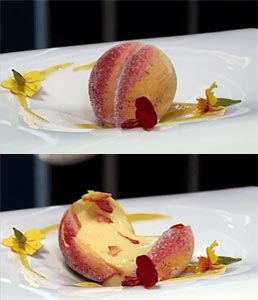
I've been wanting to try some blown sugar work after seeing a demo from Joan Roca (might have been Jordi Roca doing the demo, but Joan was narrating). I thought it would make a nice dish this week. I planned to blow sugar into a large coffee bean shape, fill it with a coffee panna cotta and dust with cocoa and ground chocolate so that it looked like a giant coffee bean on the plate.  The diner would crack the bean with their spoon like a creme brulee shell to expose the rich panna cotta within.

The inspiration: Apricot from el cellar de can roca
 
It seemed like a decent enough plan.  I worried that the panna cotta might dissolve the sugar shell before it set, but in case of disaster, I planned to line the inside of the sugar shell with cocoa butter, thinking the fat would protect the sugar from moisture and could set up nice and thin.  If only I could get to that point. 

What I learned is that blown sugar work is not something I can learn in a couple of hours. I was able to inflate a few sugar balloons, but they were all mishapen and collapsed on themselves and basically wouldn't cooperate.  Even with help, all I ended up with was something that looked like the stomach of an anatomy model, and a pretty nice round ball that promptly shattered when I tried to set it down.  So, after a frustrating evening, I punted on the blown sugar until another day.

That's improper sugar blowing technique.

It popped

Sugar Stomach...As good as it got, still not good.

Breaking Bad

Reconfiguring my dish, I made a sous vide coffee panna cotta with 400g heavy cream, 100 g mascarpone, 200g whole coffee beans, and 75 g sugar. I bagged and cooked it sous vide at 92C for 2.5 hours. I bloomed 5g of gelatin in 50g of milk an added it about 10 mintues before the end.

I wanted to stick to strictly coffee, sugar and cream in the dish, so I also did a 24 hour cold brewed coffee and made a fluid gel sauce, and served with some milk foam and coffee flavored spun sugar.

The sous vide coffee panna cotta was awesome. I was really just sort of winging it based on Chef Grant Lee Crilly's discussion of coffee butter and fat extraction of the beans. I figured the cream also had a high fat %, so it was worth a try. There was almost no acidity or bitterness, but the fruity notes of the beans really came through. Flavors that are subtle when brewed were forward and prominent in a way I didn't really expect.  I used a local roasted Terra Verde coffee which I find to be an excellent medium roast that really let's some of the herbal qualities of the beans shine.  The rest of the dish paired nicely, although didn't have the visual impact and playfulness I'd hoped for originally.  The rich creamy panna cotta, the strong roasted coffee sauce, topped with some foamy milk goodness and an ethereal sugar that started to melt into the other components.  It was pretty awesome.  And pretty much covered the spectrum of tan.  Next time, maybe some color.
 
Coffee, Coffee Cream, Coffee Sugar and milk?

Challenge coffee complete!


Monday, February 25, 2013

Better Than Nintendo Cake (for the kiddies)

It's the week 6 challenge.  And this one kicked my ass.  But more about that later.  The challenge this week was to update something your grandma would have cooked.  So let's start there.

I don't really remember my Grandma's cooking. I think that at our family gatherings it was usually my mom or Aunt that cooked. Back when I was about 10 or 12 though, everyone was at my Grandma's for Christmas or Thanksgiving or some such holiday. My cousins, brothers and I were sitting around when Grandma came into the room and announced she had made dessert. She went on to proclaim that it was called Better Than Sex Cake, laughed, then looked around at all the kids in the room and said "Well, it's Better than Nintendo Cake for you kiddies." And I think that at every family gathering since, the Better than Nintendo cake made an appearance. If you're not familiar with it, basically you cook a boxed chocolate cake, poke holes in the top and pour over a can of sweetened condensed milk, and a jar of caramel. Then spread cool whip (*shudder* cool whip) over the whole thing and sprinkle Heath bits over the top.

So, with this challenge, the first thing that came to mind was Better than Nintendo Cake.

I've been wanting to make cajeta (goat's milk caramel), so I placed equal parts evaporated goat's milk and piloncillo in a mason jar with a vanilla bean and placed in the sous vide bath at 80 C. I left it there for, let's say, about 32 hours give or take. It caramellized pretty well, but didn't thicken up the way I would have liked. I added about 0.2% Xanthan, which helped, but it was still pretty thin. It tastes really good though, so I can deal with the viscosity. I've got enough for a while too.

I made a straightforward English toffee with roasted almonds, and whipped some heavy cream and mascarpone to stiff peaks.

And, in modern cooking 1987 style, I whipped up some molten chocolate cake batter (Vongerichten style, not Bras) with 70% dark chocolate, ceylon and cayenne (no ancho to be found in my spice rack tonight, so had to make due with cayenne).

So I mentioned an ass-kicking? Well, the plating went horribly awry. I don't really have an explanation, but suffice it to say, I couldn't picture how I wanted it to look, and it somehow ended up much worse than I could have imagined.

Not my best dish by any means, but the flavors were good, though really sweet. I tried to cut back some of the sweetness with the spices and bittersweet chocolate, and a little Maldon on top with the caramel. But, yeah, it was still pretty sweet. Or as we said in the 80's Suh-weet! 


Better Than Sex Nintendo Cake - Updated?

Better Than Sex Nintendo Cake

Saturday, February 23, 2013

Control your temper...ature. Embrace the sous vide.


As you may have seen from the past few posts, I've been spending some time on a site called ChefSteps.  Basically it's a web destination for anyone and everyone who's interested in modern cooking techniques.  They are developing an online class for sous vide cooking which I've been working my way through.  There's also an active forum to ask questions, discuss knives, compete in weekly challenges, exchange recipes and ideas, or just contemplate the differences between various grades of methylcellulose, if you're into that sort of thing.  Anyway, I've been enjoying the site, and picking up plenty of tips and tricks along the way.  I thought I'd do a menu based on several of the recipes, ideas, or discussions from the site.


So I started off with Caramelized Carrot Soup.  This was a recipe featured in Modernist Cuisine, then adapted for the @Home version of the book.  I'd been wanting to try it.  Since many of the ChefSteps crew worked on the Modernist Cuisine books, it seemed like a fit.  So, I pressure cooked some carrots.  I have an old canning cooker that I use (not sure of the vintage, but the manual includes directions for use on your coal fired stove so I assume it's been around longer than the 2 years I've owned it). I adapted the recipe slightly to cook the carrots in jars, because the cooker is just huge otherwise.  After cooking, they went into the blender, through the sieve, and combined with carrot juice.  Then I added some butter, and emulsified with a stick blender until it was silky smooth.  The finished soup was topped with Creme Fraiche and Roasted Pepitos.  It was pretty damn tasty, and perfect for wintertime.
Caramelized Carrot Soup
Look at that texture.

Next up was the Salmon Mi-Cuit.  That's French for half cooked or lightly cooked.  I had some fresh Ora King Salmon that came in to my local fishmonger this week.  Early that morning, I brined it for an hour, then cooked at 40 degrees Celsius (that's 104 Fahrenheit) for an hour.  It went immediately into an ice bath to rest until dinner about 10 hours later.  It was plated with a vibrant green watercress puree, pickled onions and horseradish cream.  The salmon was awesome.  It had a texture that just melted in your mouth.  Not like sashimi, definitely not flaky, but something altogether different.  This recipe was part of the class, and looked beautiful on the plate.  The top pic is mine, followed by the ChefSteps version on the bottom.  Mine's not quite as elegant, but not half bad.  You can check out the recipe here: Salmon 104 Degrees.  I highly recommend it.    
My Salmon Mi-Cuit
The original ChefSteps Version


The entree was Beef Short Ribs.  These had been cooked for 48 hours at 64C (147F).  The long cook time allows the collagen to break down so that the ribs are tender, but only cooks the meat to medium doneness.  Contrast this with a typical slow and low braise, crock pot or smoking process which functions similarly to break down the collagen, but cooks the meat to well done.    The ribs were paired with a Chimichurri sauce (parsley, oregano, garlic, olive oil, white wine vinegar, crushed red pepper, black pepper).

I served the Short Rib with a Potato Pave that I believe originated from Chef Thomas Keller's Ad Hoc, and had been getting rave reviews on the forum.  Those reviews were well deserved.  Essentially this is a Potato Gratin, but the potatoes are sliced thin, dipped in cream, layered, and cooked until tender.  Then they are pressed together and cooled.  After refrigerating overnight, I sliced into cubes and fried the side of each.  This way, every individual potato slice was crispy on the edge.  I think I had about 25 layers of potato in these.  You should search this recipe out, because it is phenomenal.

Also with the beef, was some Brocollini that I cooked sous vide at 90C for about 9 minutes, then charred with a blowtorch and sprinkled with sherry vinegar.

48 hour Short Rib, Chimichurri, Potato Pave, Brocollini
Final Sear on the Short Rib
Potato Pave, ready to go
Creating the crust on the Potato Pave


The final dish of the night was a Lemongrass Cardamom Creme Brulee, which ended up without a picture.  These also got cooked sous vide, though somewhat less successfully.  Although they didn't fully set, they were still quite delicious, and a nice way to end the meal.  

All in all, quite a successful dinner, though it really put my single circulator through the paces trying to complete everything. Several times I put the ribs into hold mode while I borrowed the circulator to cook other items in a separate bath.  Maybe I need to get another.


Saturday, February 16, 2013

Culture up: African Groundnut Porridge with Yellow Plum and Kashata

ChefSteps Week 5 Challenge:  Cook something from a different culture with a modern twist. 

Most people consider me to be sans culture, so this seemed to be a wide open challenge.  I wanted to make something that I was completely unfamiliar with. I ruled out Asian and European cuisines since I go to those culinary locales regularly.  In the Americas, US, Canada and Mexico were out.  I considered the Caribbean or South America but ultimately decided that Africa seemed like a destination worth exploring.  I've had some African stews and one of my favorite dishes is the Inner Warmth Peanut Stew.  However, my creative cooking time this week was scheduled for Saturday morning, so I wanted something that could work for breakfast, which meant stews were out.  I will confess I know almost nothing about this dish and little about the culture of the specific region, other than what I was able to glean from the internet for this challenge. So, I apologize if I get anything wrong, but this is my interpretation. Anyway, enough preface.

My dish this week is Groudnut Porridge with Yellow Plum and Kashata. The porridge is a dish from the Central African Republic, though I expect it may travel farther than that. I'm not entirely sure of the proper name for the porridge. I've seen it referred to as Bambara, though I believe that is actually the name for the specific groundnut, not the porridge itself. I chose yellow plum because the wild plum is indigeneous to Africa and I couldn't find any horned melon which was my first choice. The Kashata is a cookie/candy of Swahili origin.

Groundnut Porridge with Yellow Plum and Kashata

For the porridge, I used sushi rice that I cooked until it had absorbed about 75% of the water. Then I added Peanut Butter (unsalted) and Sugar and finished cooking. I was happy with the texture of the porridge. Using the sushi rice made it stickier than a long grain rice (which I believe is more typical of African cuisines) would have.

The plums were sliced and cooked sous vide with a little bit of honey at 63C just until they started to soften up a bit.

The Kashata was made with sugar melted in the skillet until it was nice and caramelized, then added roasted peanuts, coconut, cinnamon and salt.  I poured it out onto a silpat and let harden to a brickle.

I plated the porridge with an improvised ring mold (mason jar ring) topped with the plum and a dusting of sugar. I did a light brulee over the top and presented with a piece of Kashata. I did 2 different takes on the plating, and was actually pleased with the final result for once. Anyway, I hope I did justice to the dish.
 
Plating Variant 1: Groundnut Porridge with Yellow Plum and Kashata

Plating Variant 2: Groundnut Porridge with Yellow Plum and Kashata

I'm not so sure about the combination of plum with the peanut. Jamie thought it worked, or so she said.  I thought everything tasted good on it's own, but not necessarily a 1+1=3 situation. I think apples would go well, or certainly banana, but I wanted to try to stick to ingredients that were native to Africa, and I don't think those qualify.  The final plating really matched what I visualized last night, which is a rarity. I'm really happy with the appearance of this dish, though perhaps less so with the overall flavor.  That said, I think it could be refined with a different fruit into something really nice.

Sunday, February 10, 2013

Challenge: Prune (or how I took some of global cuisines most sacrosanct dishes and gussied them up with prunes)

So, Week 4 challenge is complete.  This week, it was make something that you didn't like when you were a kid.  Clearly, the most challenging aspect of this challenge was to determine what I didn't like as a kid.

I figured that to get an accurate take, I should go to my mom.  I thought she'd give me something I could work with.  A dish that I could elevate beyond what I'd had as a kid into something much better.  I hoped she say Stroganoff.  I never liked stroganoff as a kid, but I think I'd probably like it now.  I've been wanting to try my hand at the strog for a while, but Jamie is more resistant.  She also disliked stroganoff as a kid.  This would be a perfect opportunity because she couldn't turn it down if it was a formal challenge.  But I didn't get stroganoff back from mom.  Instead, I got prunes. 

I don't really remember not liking prunes.  Of course, I don't really remember liking prunes either.  They were sort of a non entity in my young life.  However, I'm always telling my kids they have to listen to their parents, so, I accepted the challenge from mom.  Prunes aren't really a dish though.  They pretty much are what they are.  I thought may I could buy some plums and make a better prune, but the prospects of getting a decent plum in Wisconsin in February were slim to none.  So instead I thought about what I could do to incorporate prunes into another dish.

I thought about shrimp with plum sauce and hot mustard.  I thought I could do something there.  I came up with this idea to treat the prune as though I was making shiokombu but the prune was the kombu.  I packed 100g of prunes, 25g mirin, 40g rice vinegar, 70g sake, 30g soy, and 25g sugar into a bag and let it cook sous vide for an hour at 87C.  This kept the liquid from reducing, and allowed the prunes to hydrate somewhat.  After cooking, I removed the prunes from the liquid, and blended, adding a combination of the cooking broth and EVOO until it reached a consistency somewhat like a marmelade.  I plated with sous vide shrimp and some dollops of chinese mustard.  This is Shioprune Shrimp with Chinese Mustard: 


Shioprune Shrimp with Chinese Mustard

The sauce was really quite good, and paired well with the hot mustard.  Next time, I'd probably tempura the shrimp to give it a little crunch rather than the more delicate sous vide shrimp texture.

But I wasn't done yet.  I had guests coming for dinner, and one prune dish surely wouldn't suffice.  I took some inspiration from Michael_Natkin's Romesco entry from the challenge a couple weeks ago.  If you've never had it, do yourself a favor and whip up some romesco sauce.  It is delicious.  I made the romesco sauce, but included 10 prunes in the sauce.  I cooked potatoes, carrots, leeks, asparagus and cod sous vide.  I made a stock from the shrimp shells and cod trimmings, and reduced that with some previously made vegetable stock and carrot juice into a broth.  I took a blowtorch to some scallions I'd trimmed and plated the dish:  Prunesco Sauce with Cod and Vegetables. 


Prunesco Sauce with Cod, Potatoes, Carrots, Asparagus, Leeks and Green Onion
I served it with some Crostini to mop up the sauce.  The prunesco sauce was sweeter than the romesco sauce (I also made some of the standard recipe)  It was delicious with the crostini and leeks and onion, but the standard romesco sauce paired better with some of the other veggies, particularly the carrots that were sweet enough on their own.  I don't have any expectation that prunesco will become the new standard across Catalonia, but I imagine if you had some roasted calcots and a bowl of prunesco sauce, you'd be pretty happy indeed.

Plating

My upgraded torch - with holster
Torching onions

Wednesday, February 6, 2013

Chocolate Panna Cotta, Banana, Many Textures of Peanut Butter

This week's challenge from Chefsteps was a sous vide dessert.  I thought about banana cream pie, but got beat to the punch when someone else made a killer rendition first.  I wasn't really sure what to do, but Jamie suggested Peanut Butter Cups.  Seemed like a good enough idea: chocolate, peanut butter, pretty delicious combination.

I played around with the idea.  I thought I'd flip it, and surround the chocolate with peanut butter.  Also, throw some bananas into the mix as an homage to the banana cream pie that wasn't.  And bananas go well with chocolate and peanut butter.

I started with chocolate panna cotta.  Panna cotta is my new go to because it's easy and works as well sweet as it does savory.  This time, I wanted it to be intensely chocolate.  I cooked the cream and blended in enough chocolate to get the nice rich chocolate look I was going for.  Then, I blended in about that much chocolate again.  300 g total chocolate, to about 600 g of cream / half and half.  It seemed about right, so I added gelatin, and poured into plastic cups to set.  It was amazingly chocolately.  I licked the warm remnants from the pan. 

Next I started on the peanut butter.  Rather than run of the mill creamy, stick to the roof of your mouth PB, I wanted to play around with texture.  I thought many different textures all based on peanut butter would be interesting.  I came up with 9 different possibilities but that seemed like a lot, so I whittled those down to 5.  I'd made Powdered Peanut Butter before so that was easy.  I also figured I'd do a microwave Peanut Butter Sponge Cake a la Ferran.  Then Peanut Butter Ice Cream seemed like a good idea.  I used one of Jeni's splendid recipes and it was ultra creamy and delicious.  Then I found Thomas Keller's recipe for a Peanut Sablé, which without the accent is a type of weasel, but with the proper accent becomes shortbread.  The biscuit was good with rich buttery, salty, peanut flavor.  I should've rolled it a little thinner, but it worked pretty well.  And finally, I figured I'd do a Peanut Butter Sabayon.  Which is the French version of the Italian whipped custard dessert Zabaione, only with peanut butter.  As far as I could tell, no recipe exists for a peanut butter sabayon.  I adapted the Modernist Cuisine at Home recipe with a big scoop of peanut butter.  It was rich and delicious, yet airy and light and still warm when served.  Even with three N2O charges though, the foam didn't quite hold.    

I thought I'd caramelize the bananas, then decided I wanted a little more fruit, so I also poached some bananas in a bit of honey and cinnamon.  That's a good combination.  Banana, honey, cinnamon.  Put it in a ziploc bag, squeeze out the air, and throw in a 60C bath for about 20 minutes.  Yum.
Chocolate Panna Cotta, Banana, Many Textures of Peanut Butter

Chocolate Panna Cotta is in the center topped with Peanut Sablé.

12:00: Powdered Peanut Butter
02:00: Peanut Butter Ice Cream on a bed of shaved Chocolate
04:00: Cinnamon Honey Sous Vide Poached Banana
05:00: Peanut Butter Sponge Cake
07:00: Caramelized Banana
10:00: Peanut Butter Sabayon (sous vide)

The plating ended up a little messy, but I think the overall effect worked out ok.

Oh yeah, and I was picked as one of the winner's of the challenge!  Check it out.  And look at Chris Koller's Raspberry Chocolate Gateau.  It is absolutely gorgeous.  Obviously I need to work on my presentation skills.

Sunday, January 27, 2013

BarBiBimBapQue


BarBiBimBapQue


I finally stepped up and got my thermal immersion circulator (Polyscience Creative unit), and signed up for an online class on sous vide cooking.  As part of the class, I get a weekly cooking challenge.  This week's challenge was a vegetarian entree thrown out by Chef Michael Natkin of Herbivoracious fame.  I do cook vegetarian on occasion for the family, and also friends who are of the vegetarian persuasion.  When I've forgotten that certain things like chicken stock and gelatin are not vegetarian per se, well, it's good that my friends are understanding.  So I thought I'd take the challenge a step further and go full on vegan for my dish.

Thermal Immersion Circulator

My first thought was to do bibimbap, because, let's face it, bibimbap is delicious and fun to say.  But converting bibimbap to a vegan dish didn't seem all that challenging.  Asian cuisine in general seemed straightforward to cook vegan.  So that was out.  I hit upon the idea of southern cooking and traditional barbecue.  Not the type of food that's typically vegan friendly.  This had the potential to be a really terrible idea.  In other words...right up my alley.  With bibimbap still on my mind, I thought I'd take the bibimbap bowl concept and adapt it to southern cooking and barbecue, while keeping it all strictly vegan, and maybe throw in a few Korean / Asian ingredients, fusion style.  .  

First off, I needed to ditch the bibimbap rice component, because they don't believe in rice down south (I know, I know, but I'm making a point here).  Rather than rice, I thought I'd use grits.  For the toppings, I had barbecue, sweet potato, collard greens, okra and peaches.  That's a good old fashioned southern meal in a bowl.

Now, because this is a sous vide class, I did need to use sous vide as one of the techniques in creating the dish.  All of my experience with sous vide is with proteins and eggs (yes, still proteins), so vegan sous vide was treading new ground.  I thought that a corn cob stock would be a good way to amp up the natural corn flavor in the grits and bring in additional flavor and richness, so I made a sous vide vegetable stock with onion, carrot, celery, shitake mushrooms, lemongrass, garlic, parsley, cilantro, and some corn on the cob (Adapted from Chef Cohen @ Dirt Candy).  I bagged everything up with some water and threw it into the 85C water bath. 

Making stock
Sous Vide corn cob stock

While that was cooking, I started on the sweet potato.  I always like to top my sweet potatoes with some maple syrup, toasted pecans and a shot of bourbon, all flavors that also go well with bacon.  So why not treat the sweet potato like bacon?  I sliced the sweet potato into thin slices (that looked sort of like bacon) and created a marinade of maple syrup, bourbon, miso, and soy sauce.  I threw this into the water bath with the stock to cook and infuse the marinade.

Sweet potatoes marinating

After 3 hours (stock) and 1 hour (sweet potato) I pulled everything out of the bath and put it into the fridge to cool and continue to infuse overnight.

Sous Vide Bath

I wanted to have a pickled component and thought the peaches would lend themselves well.  The next morning, I sliced up some peaches, and simmered in a pot of sugar, vinegar, cinnamon, clove, allspice and star anise.  Then I covered the peaches in the syrup and put into the fridge.  Ok, ok, I ate a few too.  These were freaking awesome peaches.  I'd never pickled peaches before, but I'll be doing this again for sure.

For the barbecue, I thought I'd use tofu. I sliced it into 3/8" thick pieces, dried it, and seasoned with some salt and pepper.  Then I smoked it at a low temp over some cherry wood smoke.  I also smoked the sweet potato slices at the same time.

Collard greens are a challenge because I've always cooked them with smoked pork of some kind or another.  However, I adapted a recipe from the Herbivoracious site for vegan collards that used shitakes and soy to flavor the greens.  While these were simmering, I started on the grits.

I treated the grits essentially like I do risotto.  I sweated some garlic and onion in olive oil, then added the grits to toast.  Rather than white wine like I'd use for risotto, I added some beer (Tallgrass 8-Bit Pale Ale), then continued to stir while it was absorbed.  I added the corn cob stock a little at a time, continuing to stir and let the liquid absorb.  I finished it with some corn cream (basically corn pureed with water in the blender into a rich smooth paste (Thanks to Dirt Candy for this idea too!).

I got the tofu and sweet potatoes from the smoker.  The tofu was glazed with a barbecue sauce made from gochujang (Korean chile paste), molasses, sugar, mirin, and sesame oil.  The sweet potatoes were glazed with maple syrup.  I took the torch to each to give it a little sear / caramelization.
Sweet Potato Bacon

Barbecued Tofu

Finally, I sliced up some okra, tossed with olive oil and salt and roasted in the oven.  

After that, all that was left was assembly.  I topped the grits with each of the components and then poured a little bit of corn cream around the side.  And there it was.  Barbibimbapque.  

Barbibimbapque - Southern Barbeque / Korean Bibimbap Fusion

The grits were absolutely phenomenal. Probably the best grits I've ever had, and they were just singing with corn flavor.  The flavors of all the components worked both on their own, and together in the dish.  The heat and smokiness of the barbecued tofu balanced the sweet-sour peaches.  The sweet potato bacon was sweet, smoky, salty and tasted like sweet potato. The okra was crispy and vegetal.  And finally, the collards added some bitterness from the greens countered with a woodsy umami punch from the mushroom and soy.  All in all, it worked out pretty well.  I don't know yet if I'll win the challenge, but I gave it a good shot.  And last, but not least, you know what's more fun to say than Bibimbap?  Barbibimbapque!